Hi Stephen, thanks for the follow-up. I hope others will contribute their experiences and perspectives.
As I reflect on civil engineering, I have come to realize that the discipline is fundamentally all about risk management. Almost everything we do as civil engineers has a probability of failure. For many aspects of civil engineering, this risk is addressed via codes, standards, and guidelines, referred to as the Standards-Based Approach (SBA). The safety factors and load and resistance factors that we use have been calibrated from analysis or anecdotal experience to yield societally acceptable levels of failure. Perhaps this historic reliance on the SBA has contributed to risk management becoming a secondary activity rather than the primary work.
------------------------------
Mitch Winkler P.E.(inactive), M.ASCE
Houston, TX
------------------------------
Original Message:
Sent: 07-18-2025 12:12 PM
From: Stephen Leach
Subject: Application of Bow Tie Diagrams for Managing (and Communicating) Risks
Dear MItch
Your comment:
Stephen, Thanks for your response and observation. Could you tell us more about your thinking behind this comment "the subject of risk management is a developing area of managing and implementing projects"? It might help expose some areas we might explore in this CoP.
The software and other tools being used in the design and management is developing and changing and we need to explore ways of increasing the integration of risk management into design packages & BIM processes and then link these to project risk management. The development of risk registers and risk matrices currently prepared in separate / isolated documents separate from the design packages and software tools often result is design related risk items not being covered or not fully covered. Would be useful to get comment from the Engineers.
------------------------------
Stephen Leach C.Eng, M.ASCE
Consultant Executive
Luling LA
Original Message:
Sent: 07-16-2025 08:23 AM
From: Mitchell Winkler
Subject: Application of Bow Tie Diagrams for Managing (and Communicating) Risks
Stephen, Thanks for your response and observation. Could you tell us more about your thinking behind this comment "the subject of risk management is a developing area of managing and implementing projects"? It might help expose some areas we might explore in this CoP.
------------------------------
Mitch Winkler P.E.(inactive), M.ASCE
Houston, TX
Original Message:
Sent: 07-16-2025 07:55 AM
From: Stephen Leach
Subject: Application of Bow Tie Diagrams for Managing (and Communicating) Risks
Mitch the subject of risk management is a developing area of managing and implementing projects. I have never used the bow tie methodology but the limited research I have done would suggest this is a useful tool for "root cause analysis"
------------------------------
Stephen Leach C.Eng, M.ASCE
Consultant Executive
Luling LA
Original Message:
Sent: 07-13-2025 08:27 PM
From: Mitchell Winkler
Subject: Application of Bow Tie Diagrams for Managing (and Communicating) Risks
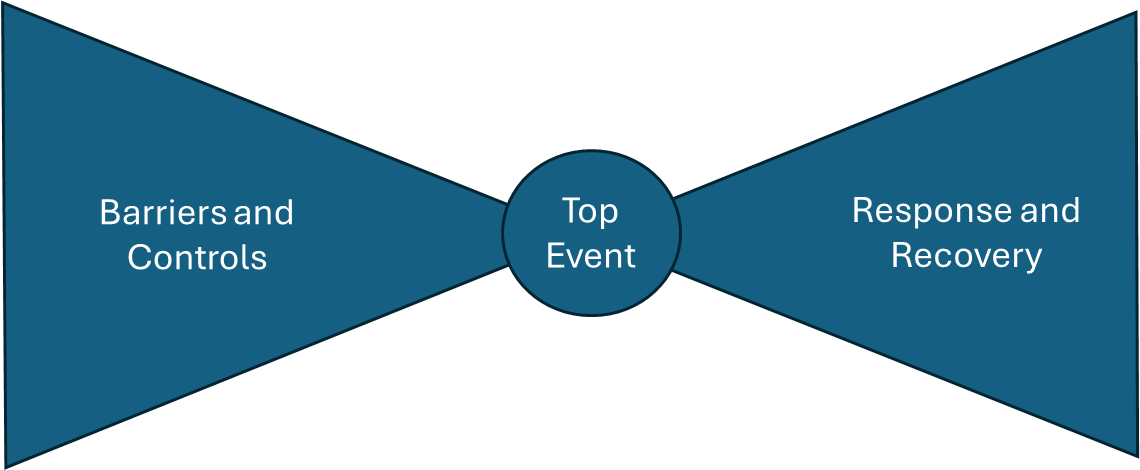
Have others come across the use of Bow Tie diagrams as a means of managing risk, and what were the circumstances? They can be as complex as you want. In their simplest form, they depict the mitigations, referred to as barriers and controls, to prevent something bad from happening on the left, and the options for response and recovery on the right. The bad thing could be a loss of control or failure, and is referred to as the top event.
The flooding disaster along the Guadalupe River in the Texas Hill Country prompted me to think about these diagrams. They provide an insightful framework for piecing together all that happened and for thinking about the future. Besides providing a framework for managing risks, they can be invaluable for communicating risk to others, based on my experience.
------------------------------
Mitch Winkler P.E.(inactive), M.ASCE
Houston, TX
------------------------------